From Potawatomi Skokie, USA, to Spanish Madrid.
From “Big Swamp” Skokie, Illinois, to Capital de España.
Then, via Dubai, to East Africa on the Indian Ocean …
From one world, reality, to another to another …
Potawatomi Musings
A walk in the woods in “Big Swamp” Skokie. Late Spring, flowers everywhere. Brown and grey six months ago, dead, dormant; now the greenest of green, intense, lovely.
 |
Yet I dream of elsewhere, or elsewhere dreams of me, draws me on. Dreams dreaming, elsewhere beckoning.
Potawatomi musings. A people long gone or "disappeared". Diaspora diaspora. A language dying, spoken only by the faithful few. Clinging, clutching, clamoring. Whispers whispering, then silence of the silenced.
The woods along a trail, fallen acorns, red oaks lining the path. A squirrel darts out, spots the intruder, me, then flits away.
Raspberries, chicory, wild grapes, black walnuts, Lilly Michiganense red and orange with purple spots; so much, too much to see. And white-tail deer that do not flee if you pretend you do not see them. An amusing hoax. What kind of fool do these dear deer take me for? Of course I see you, stupid!
 |
“Bosha, nitthena?” “Hello, how are you?” Before the 1838 Death Walk? …
And now I'm dreaming of another place — Africa. I’m learning to say, “Habari” and “nzuri". And free of their own colonial past they, the native African people, are free to speak their own melodious language.
“Habari rafiki yangu”. I like the sound.
The lion, the elephant, the giraffe. Real and symbolic. Another world beckons, calls.
Nairobi
On the taxi ride into Nairobi I brought up the issue of buying liquor in Kenya. Recently the evangelical president of the country had decided that Kenyans were drinking too much and imposed new rules. One was that grocery markets could no longer sell liquor. The other was that bottles were to be clearly labeled that alcohol was harmful to your health. Duh! Did anyone ever think it was good for your health?
“No problem,” said the driver. He stopped at a store that sold liquor and we stocked up on Johnnie Walker Red Label and Tusker beer. Then we finished the trip to my apart-hotel on Ring Road in the Westlands area of Nairobi.
I soon learned that the merchants’ response to the ban on selling liquor in markets was to move the liquor to a store next door. As to the labels about your health, you could just not read them.
At Nelson’s Court apart-hotel on Ring Road, Elizabeth at the desk decided to shut down and walk me over to the market, a large Carrefour with its liquor store right next door to the main market. I deepened my commitment to Tusker beer in the coming days and was introduced to the wines of South Africa. I skillfully avoiding reading any warning labels.
While I successfully crossed Ring Road to get to the Westgate Shopping Mall on Mwanzi Road, it was not easy with the volume of traffic on Ring Road. Elizabeth suggested using Uber to go to the market. It was also safer from would-be phone or bag grabbers. I was hesitant to do so, but when I found out the price of an Uber ride — almost nothing — I saw her point. Not only was it cheap, it was fast; It took about one minute for a cab to show up. You also avoided tripping on broken sidewalks and falling into open drainage trenches.
Westfield Shopping Mall was heavily fortified with security like most businesses in Nairobi. A few years back Westfield was attacked by an Al-Shabaab terrorist group from Somalia and some 70 people were killed. Thus most business in Nairobi are enclosed in compounds with security at the gate and more inside.
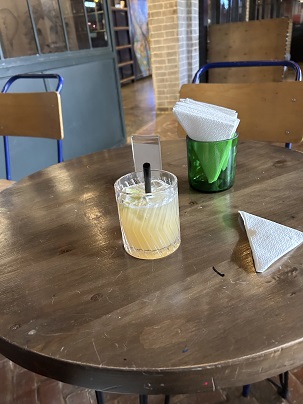
I soon introduced myself to the ArtCaffee and to Nairobi Street Kitchen. At Nairobi Street Kitchen, I tried the Dawa cocktail for the first time and sampled two traditional Kenyan dishes: Nyama beef stew and Mukimo, a dish made from mashed potatoes, green pumpkin leaves, and corn. Both were quite delicious and paired perfectly. More later on the Dawa cocktail at Nairobi Street Kitchen and elsewhere. Dawa, by the way, means health, and it is served without a warning about your health. Cheers!
 |
I also began little conversations involving Swahili language. One of the checkers at Carrefour and I began to discuss the English expression “so so”, translated “hivyo hivyo” in Swahili. And a waitperson at the ArtCaffe and I pondered the difference between English “mediocre”, or “wastani” in Swahili, and English so so, or hivyo hivyo in Swahili. Was “wastani” worse than “hivyo hivyo”? She thought so. And I agreed. I'd rather have a poem of mine called so so than mediocre!
I also entertained myself by reading poetry at the Ballpoint Social Club in Nairobi, which has a fine restaurant and good bar. With all the lovely female African poets that read there the event had all the elements of a fashion show.
 |
I only had two weeks in Kenya on my eTA, or electronic travel authorization — the latest travel curse of the bureaucrats — so I crammed in one more event while in Nairboi, a modest Safari.
Modest Safari
A safari is the dream of almost every tourist visiting Africa. To get in one of those pop-top caravans, raise a little dust, and visit the elephant, the lion, the giraffe, the zebra, the impala, the … and to shoot photos to show back home!
Thank god or the universe these people no longer arrive with guns anymore to kill these lovely creatures. In most cases the iPhone has replaced the big-bore hunting rifle of the past, unless you are Don Jr. or Eric Trump, who even get special permits to kill endangered species.
Nairobi National Park is right next door to the city of Nairobi, providing an exotic backdrop for viewing all these animals and occasional visits by lions and other animals in the city. This is because the southern border of the city is not fenced. Alerts are issued when escapes occur but there have been fatal encounters.
While there are many vehicles zooming around this park pursuing the sight of these wild creatures with city view in the background, I think I would prefer to see them in a totally natural environment. That said, here are some of the animals we encountered (black rhino left/above, impala on right/below):
.jpg)
.jpg) |
My next stop was Dar es Salaam in Tanzania.
Getting Out
“What has happened to the internet?” I asked at the desk of Hotel Nikko Tower.
“It will be back up tomorrow,” I am told.
It wasn’t. Nor the next day either.
I called my daughter in Spain to find out what was going on. It was a day after the 29 October 2025 presidential election in Tanzania.
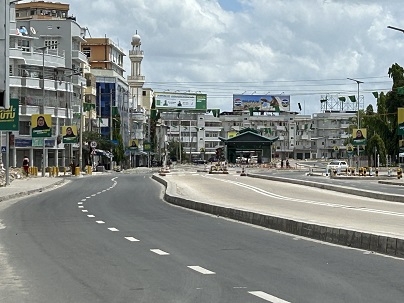
I was in downtown Dar es Salaam. The streets were empty, and I was told I should stay inside.
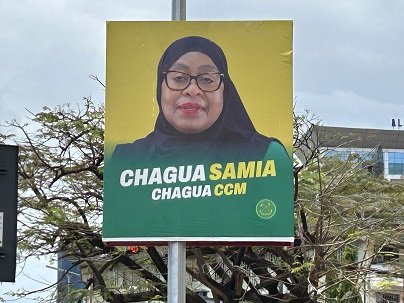
I didn’t. I went out to photograph an election poster of Samia Suluhu Hassan on Bibi Titi Mohamed Road. I had been looking at her pudgy face for weeks now on posters that lined every street. I wasn’t sure whether she was good or bad. Now I knew.
 |
The daughter reported that some 700 people had been shot dead protesting the election in which Samia ran against herself, the opposition candidates either in prison for treason or otherwise disqualified from running.
Samia got 98% of the vote. There was outrage, and youth was quick to react. It took to the streets. And Samia’s supporters, the police and the military, were quick to react too. A month and a half later the “government” has yet to report the death toll. But there are photos of bodies piled in morgues and evidence of shallow graves at Kondo cemetery to the north. It’s an ugly picture but Samia would have you believe she saved the republic.
And to teach her subjects a lesson, she shut down the internet, imposing a news blackout; closed the stores, including the markets, imposing food shortage and insecurity; and imposed a lockdown or stay-at-home order. While people may have been initially amused by this, like when kids don’t have to go to school because of bad weather, they were not amused for long.
I had been having a jolly good time up north in Masaki before all this. I had been going to the local market, Shopper’s Plaza, via motorized rickshaws or tuk tuks. It was well stocked with wine and beer, unlike other markets to the south in the core downtown of Dar es Salaam. Why I don’t know. I think that it was the Muslim influence in the core downtown area with its big mosque; alcohol was treated more like a sin there than a way to relax and celebrate. Many of the markets downtown had no liquor at all. Maybe pulling a long face while longing for a glass of wine or a bottle of beer was regarded as a form of spiritual sacrifice to the Holy One; I don’t know. But I did know that my meals tasted better with wine than with water. I was not trying to live the life of a monk. Nor was I a great sinner. Life is, after all, a balancing act involving grace and balance.
As I said I was having a good time just going shopping and wandering around much of the time with a breeze on my face from riding in a tuk truk and taking in the scenery, which was a little different from the downtown gridlock of bumper-to-bumper automobiles and delivery trucks.
 |
In Masaki stores and restaurants were spread out and traffic flowed. Life was not a dream but it was easier. Along the sides of the roads was always a broad space between road and the walls that enclosed houses in compounds. Inside the walls it was a kind of mystery. The affluent lived there. Who were they? They had gates to come and go and security, and yet the gates rarely opened and it seemed that coming and going was limited. Were the people behind the walls happy? Did they ever smile? Did smiling cost money and so was prudently avoided? Did smiling incur a certain political risk? Were they the sons and daughters of well connected politician and were their houses and cars bribes for approving large government contracts? Were they concocting plans to exterminate the low-class riff-raff that lived on the other side of their walls selling pineapples and coconuts and roasting hotdogs for poor people like themselves who could at best afford red, green, or blue tuk tuks but not black Mercedes with tinted windows? Who knows? One can only speculate.
 |
There were some nice restaurants along these colorful roads. Like Epi d’or. I had a roast-chicken and avocado sandwich there one day — there were fancier things on the menu but it was what I felt like eating — with a glass of sauvignon blank from South Africa. And I watched the kids play in a playground there while their mothers enjoyed lunch. I don’t know who was happier, kids or moms, or me just watching? I talked to a security guy later who liked the image but said he probably couldn’t afford to eat there. My research told me he was right. Security guards and housekeepers are the poorest-paid jobs in Tanzania. So we are back to the stone wall that separates the rich and the poor. I thought of the French Revolution for a moment and Victor Hugo and Charles Dickens but let the image go. It wasn’t profitable for me to think that way right now and I was having a good day. Was Samia? Did the death of some young Tanzanians, surely “rude troublemakers”, bother her conscience, if she had one? Would a bribe or two, embezzled funds, the appointment of family members to high positions where they could enjoy similar benefits, appease a troubled conscience? Could murder be forgotten while benefits were being enjoyed? Could a strong detergent remove the stains from the garment, make all new? Time will tell.
 |
I was even pursuing a passion of mine for cocktails. I had the fantasy that I was on a journalistic adventure to discover and reveal the essence of the famous Dawa cocktail. I had had one back in Nairobi at the Nairobi Street Kitchen and another at the ArtCaffee. They were quite different. Now I was going to have one at the casino bar in Masaki and another cocktail called the Mazizini Mule. The bartender there did not know the latter drink but was willing to give it a try. Was I becoming a little unhinged? Was I losing my grip on the basics. Considering what happened next, I would have to say so. Shortly the “Mule”, if you will, became the least important thing I knew. Mule, I know thee not, patient hybrid!
But before Samia interrupted the flow of events, another set of circumstance offered a prelude. I was staying at an apart-hotel called Afripoa in Masaki where almost nothing there worked as advertised.
Here is my review on booking.com:
I was there for two weeks and one day. The AC began to fail on day one and it was never fixed. The main lights had a blinking bulb that made the lights impossible to use. It was replaced by one small lamp. There was never in two weeks and one day water in the sink in the kitchen because of a water leak. Water pipes were turned off. This was never fixed. The shower had no curtain; there were no safety rails and no safety mat. One of the most dangerous showers I've ever seen! Water went all over the floor. I asked for a mop but it was never given. I wish I did not have to report this!!!
After two weeks and a day I returned to Hotel Nikko Tower in downtown Dar es Salaam, an excellent hotel where things do work. But there the real adventure began with the upcoming election.
But for a few days with lights that did not blink on and off and shower that did not leak all over the bathroom floor, I maintained the illusion that things were back to normal; and I even plotted my return back up north where the markets were better and buying a beer or bottle of wine was not considered a sin. I even booked a place up north called Mikocheni Comfort and was looking forward to being comfortable and returning to my life of adventure and discovering cocktails. But such was not to be.
Twenty-nine October was the presidential election day. And on that day real life stopped in Dar es Salaam. The first thing I noticed on waking up was that there was no internet; or to put it another way, there was no news, no email, no information. That is when I was told at the lobby that it would all be back up tomorrow. But it wasn’t. And I was told that it was best to not go outside. Nevertheless I did. The streets were almost empty. I went to an ATM machine over at Maisha Market and found that it could not dispense cash. That was a bit disturbing because I thought that I might be needing more cash. Since the internet was down I could not use Uber to get to my new “digs” up north, and the cab driver at Hotel Nikko Tower only took cash. I wrestled with this problem for awhile without a solution.
 |
Then Gloria, my new landlord at Mikocheni Comfort, called and said she would send a cab from the Julius Nyerere airport to pick me up. That sounded like a deal. But why? Did she just want to get me there so she could collect the money from booking.com? I didn’t know but I delayed moving a day, as it looked like I needed more time to assess the situation. That is, I wanted to figure out just what was going on. That seemed “prudent”, a word I generally despise. But everything seemed troubling and in need of assessment. I extended a day at Hotel Nikko Tower and discovered that I could call out of the country on my T-Mobile phone based in the US, unlike everyone else at the hotel, and find out what was going on. I called my daughter in Spain and she read me the news. When I told people in the lobby of Nikko Tower they appeared skeptical. One older guy in the lobby even looked angry and stated, “What does The Times of India know?” The Times indicated that up to 700 people up the road on Ali Hassan Mwinyi Road had been shot and killed — too far away to hear the shots at the hotel.
From my hotel room I looked out the window to the main highway and saw no traffic. I decided to walk over and shoot a photo of Samia on an election poster. I did so but on the way back I was warned by new friend Luka that shooting photos could be dangerous. I think he knew more than I did even though he could not dial out of the country to get the news. I took him at least partially seriously. I saw Luka the next day and he said he was running low on rice. I still had some food but was running low on Scotch. The situation was no longer amusing to either of us. The previous day we were a little like kids that didn’t have to go to school. Now we were seriously assessing the possibilities. And who was responsible for all this? The chubby-faced woman on the poster wearing a veil who had just reelected herself president by locking up or disqualifying the opposition. Her visage went from pudgy to evil. Or as one of my tuk tuk drivers said, “No one likes her.” Before the election when the stores were open and you could buy food, some may have liked her at least provisionally. Now no one did. She had locked us all up. She was now a tyrant, threatening and evil.
The next day a cab from the airport arrived and I moved up north to Mikocheni Comfort. But in doing so we went through many checkpoints along the highway. But at this point it was unclear why. The actions of the previous day, the protests of the election, were over. Nevertheless both driver and I handed over our IDs as we drove along the highway. I think it was just a power thing at this point — a show-you-who-is-boss maneuver. I have been through the same thing in Ukraine but it made sense there; it had a purpose and moreover they showed respect.
At Mikocheni Comfort the art work was exotic but I had some serious assessment to do. One of the markets, Village Supermarket, was open part-time now but it only took cash. But I was running out of cash and the ATMs did not work. That meant that even if the markets fully reopened I would soon be unable to buy food. Thus it was obvious: I needed to get out.
 |
The clincher came when I discovered that I would not be able to get out any time soon. Online purchases were not possible and Citibank in Tanzania (one of my banks) was closed for at least a week I was told by security when I paid the bank a visit. Since my cash was running out I needed to get out soon or I would have no food and no money to get a taxi to the airport; Uber, like everything else, did not work because the internet was down.
Soon I decided was the next day. But how? A call to the US Embassy in Dar es Salaam gave me a plan. I was given the number of Kenya Airways both in Kenya and the US. I started making calls and was able to book a flight out the next evening, leaving me ample time to get to the airport. One hitch, however, was that I could not pay Kenya Airways online. Thus Kenya Airways sent a payment request to my daughter in Spain. She paid and I then got the reservation numbers I needed to collect a ticket at the airport. But the situation was still iffy.
The next problem I faced was getting to the airport with very little cash. I decided to get started the next morning at 9 AM. I got some anxious sleep. I was tired of this mess. Samia had done a job on us, all of us. At least I didn’t get a bullet in the back!
I was up the next morning at 9 AM and ready to go.
But getting out was no easy trick.
With limited cash I decided that a tuk tuk would be cheaper if one would go all the way to the airport. I walked out to the street in Mikocheni and almost immediately got the attention of a driver going down the street with a friend. He stopped the tuk tuk and we had a conversation about going to the airport. He said he could do it. He was a young Muslim guy with a full beard. He looked tough and determined. I loaded my bags into the passenger compartment and we stopped at a gas station for more gas. Then we zoomed along smaller back roads until I could see downtown Dar es Salaam across fields in the distance to the east — it looked deceptively exotic, enchanting — then we headed west on a main highway with a lot of traffic towards Julius Nyerere airport. We encountered no security checkpoints anywhere. At the airport I paid the driver 40,000 TZS, about 16 USD, which was a bargain. And I tipped him some more. I was hugely relieved to have made it to the airport. There was now hope.
I then settled in and waited till 11:30 PM for the flight out. There were a lot of other people doing the same thing. I had booked the latest flight out in case there were problems getting to the airport. I double-checked with airport information that all was good, then killed time. For once the killing of time was a pleasure, not an annoyance. There was an older guy like myself waiting there. He told me there were bullet holes in the windows of an apartment near his. I didn’t ask but I think that is what prompted his leaving Tanzania. He was not faint-hearted. He was a retired special forces “operative” from Norway.
About 11 PM a whole group of us were gathered around the gate for our departing flight to Nairobi. It was raining, as it had been off and on all day. We were a motley bunch, a lot of Europeans, some Africans, and others. But I think we were all there for one reason; we needed to get out. Walking down the gangway, or “passenger boarding bridge” as it’s officially called, to the aircraft was a relief and a pleasure. And seeing the rain on the runway added drama as we hoisted luggage into overhead compartments and squeezed into our seats. The anticipation of being gone was pure pleasure. Samia and her thugs could have their country for now. Later it appeared that her only regret was that she could no longer borrow money from the IMF!
 |
Not All There
On 5 November 2025 I was out in the early hours of the morning, but I was not so sure about my state of mind. I stood at the check-in desk of the Best Western Uplands Hotel in Nairobi. Who was I? Was I the person standing at the desk or was I really someone else now? The stress seemed to come oozing out of me. I pulled out one payment card, and it was declined. I tried another. It was also declined. We tried both again. Neither worked. This was the wrong time for a card to fail, absolutely the wrongest of the wrong time! It was the ultimate banking SNAFU. I just wanted to check in and relax, shed all anxiety. About the fifth time one of my cards worked. I have no idea why. If something is not going to work, let it really not work. But when it worked the fifth time, I didn’t dispute it. But when I got my door key I headed to my room accompanied by a hotel concierge. While I said I didn’t really need help he intuited that I really did need help and trailed along with me. But by the time we got to my room I had lost the door key and did a lot of nervous fumbling through my stuff to find it.
“I don’t get it. I really don’t , I, I …”
I was mazima, or a little crazy.
“I can get another”, the concierge said gently just as I found it.
He was really very kindly. He could see that I was a mess and knew that I had just escaped Samia’s coup. Maybe he had met other guests who were a little messed up too. He was really most kindly, most kindly when I had lost my key and stood there totally baffled. He was a tall man, very dark with low mellow voice, and very gentle and kind.
Finally in my room with my bags, I relaxed and unwound; two days later I moved over to an apart-hotel over in Alzania Jay Homes on Mau Close in the Westlands area of Nairobi. I was mentally back.
Poetry Here, Poetry There
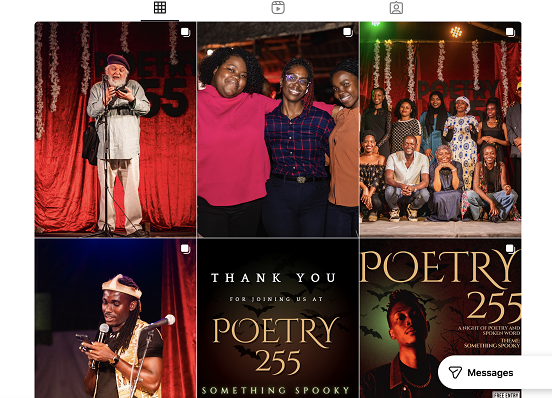
One good thing: Before the election in Dar es Salaam I read poetry at the Goethe Institute as part of a Poetry 255 event. It was like a party, not what I was used to in Paris or London or Whales when I read. I liked it. There was a barbeque, lots of drinks, and free deserts and coffee at the intermission.
I said to a woman sitting near the barbeque, “This is not like in Paris.”
“Oh”, she said thoughtfully, “what’s it like in Paris?”
I was at a bit of loss to say but hastily scrambled together a response.
“In the late 1800s and early 1900s it was rather formal. The photos I’ve seen show seven or eight poets, all male, formally dressed, some even wearing top hats. The events were held in what I believe were small banquet rooms in restaurants, fish untouched on a plate in the center of the table and a decanter of wine and water. The readings seemed to be very intense, very focused. There is nothing very joyous about it. They were informal enough, however, that if the young Arthur Rimbaud were there he would interject the word “merde” in the middle of a line if he did not like it.”
“Here it is quite the opposite,” I went on. "No one says ‘shit’ if he or she does not like a line, and the lines are much freer. They are not subject to rhyme or meter; though they can include those elements if the poet, male or female and colorfully dressed, so chooses. Get the picture?”
“In general,” I summed up, “your readings are more fun. And in Paris there is booze but nothing to eat. Maybe a plate of charcuterie. But no feast like this!”
The show was starting up again, so I didn’t get her response. But the severe expression on her face told the story. She wore a burgundy red dress and had a wonderful tuft of hair that extended out over her forehead. She did not have the thick parted braids, so favored by most African woman.
The event was held at the Goethe Institute, so I began my reading with “Gutten Abend”, then launched into a brief passage from T. S. Elliot’s Wasteland:
Frisch weht der Wind
Der Heimat zu
Mein Irisch Kind
Wo weilest du?
The previous reader had made reference to Ulysses and his long wondering after a war before returning home. It was once again the story of a lost generation.
I then read from my own bitter poem about travelling called Bard on the Road or Travelling Twisted.
"All is vanity," says the Preacher. Is he right?
"Travel is so broadening," says the Satirist. Of course he doesn't mean a word of it.
And the Humorist tells of "Innocents Abroad," a bunch of smug American mumblers and bumblers who misinterpret almost everything they see.
"All is vanity?" The Preacher is probably right.
A trip to Shanghai and an overpriced drink looking over a polluted river. What's the lesson here, class?
A cruise on the Seine River and a "pulled" wallet, either literally or figuratively. Who's the dummy, dummy?
And self deception: "Life is good!"
Then home to roam the dark allies of your mind—gum on soles, soul-gum slime.
…
There must have been fellow travellers in the audience, because they got it; I heard low chuckles in the audience at the end of many of the lines.
 |
Moses
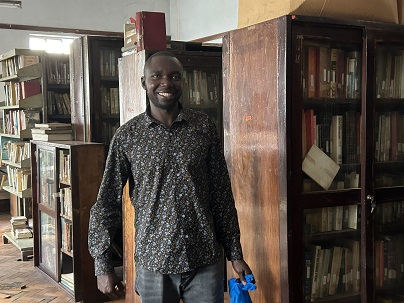
He was a delight in every respect. Tall, thin and with big smile he stood by the gate at the front of the building whenever I came out of my apartment at Azania Jay Homes on Mau Close. Almost always he had a stick in his hand and did a little dance as though on stage. And he always knew the word I wanted in Swahili.
“Paka”, he told me was the word for cat.
“What about black cat”? I asked.
“Paka mweusi” he said with a grin.
I told him about the famous Black Cat or Au Chat Noir, in Paris. He looked intrigued.
He looked like he could have been a dancer or comedian on stage.
I told him one day that he should be a language teacher. He smiled very pleasantly and thanked me for the compliment.
It only dawned on me later, back in Madrid, that he was a Maasai warrior, once the most ferocious warriors in Africa. But they had another side to them. As part of their traditional culture they made up stories and told jokes; these days some worked as comedians in Nairobi. Once only cattle herders and warriors, they had branched out, adapted. And yet there was something in them that was not part of the times, this world, but rather danced or soared above and beyond it.
He wore the blue blazer of the traditional security guard in a fancy building, but it was easy to picture Moses in the traditional red or blue or plaid combination shuka, a dress-like garment wrapped around the body and over the shoulder. He was as colorful as you can be without being all party ribbons and balloons. He was perhaps the most adaptable person I have ever met who was still grounded in the here and now. If he were a type, he was “another“ type in the drop-down box in the qestionnaire. I wish I had a photo. If I did I think it would be one of the sky.
Or let me put it another way:
The stick he waved in his hand
Was really a magic wand
His smile an expression of joy
…
But let me come back to this.
Grab Bag
The largest slum in Africa, and the second largest in the world, is at Kibera in Nairboi. I chose not to go. But there is a paid tour for those who want to see small children growing up in poverty along with their parents. If there were a tour showing the many ways they were being lifted out of poverty, I would be the first to attend. An alternative tour, I thought, might be this: A free tour for the impoverished to go and see the privileged living in back of high walls in compounds with security at the gates. But I don’t think it would inspire them to anything other than rebellion. On a positive note: I took a cooking class and we shopped at one of the markets at Kibera, which consisted of a tunnel-like compound of canvas-covered produce stands with some very good-looking fruits and vegetables. Power to the people and to fruits vegetables!
 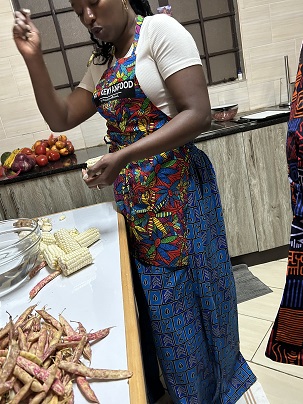 |
Whatever happened to the modesty of Muslim woman? It was not on strong display while I was at Dar es Salaam in Tanzania or in Nairobi in Kenya. And I am glad for that. I got to know several Muslim woman and they were a lot of fun. And it defied the stereotypes that I have grown up with. Though I only saw a small part of them, their faces, they were fully naked in terms of their expression and feelings. Maybe I got to know them better that way. One named Mya worked in an electronics store in Nairobi. Even though we differed greatly in age, she came onto me in a way that was proper yet jolted my feelings. I was a little shocked by my attraction to her. She asked where I was from, what I liked to eat, told me what she liked to eat (seafood, she was from a small town on the coast) … Another in Dar es Salaam worked at Maisha supermarket down town. She decided to go shopping with me and was in fact very helpful in finding things. After I paid at the register she walked out of the market with me and wandered through other parts of the shopping center with me, talking and asking questions. “Was I a Muslim?” she asked. “No,” I told her. It didn’t seem to bother her. We walked and talked as if we were two young lovers. Pretty silly, really. I did not take it seriously but was amused in a pleasant sort of way by the whole thing. The third incident of baffling Muslim female lack of modesty came at a hotel in Masaki in the north of Dar es Salaam. A young Muslim woman worked in the office there, and whenever I went to the office she was bent low in back of the desk and smiled mysteriously when I came in, covering her lovely large breasts which were partly exposed. She also covered her hair. This left me baffled. Did I not understand something about modesty? I thought bare breasts and exposed hair were for husbands only? I think in most cases that is so. What was she up to? What did this all mean? I was not a Muslim psychiatrist so I will probably never know. Naturally it was arousing — she was very good looking! — but I left it at that.
As I mentioned before, my curiosity regarding cocktails was cut short by the aftermath of the elections in Tanzania. Before the election I had talked with one of the bartenders at the Karambezi Bar in Masaki about the Mzizini Mule. The Dawa cocktail was well known; this cocktail was not. Nevertheless I persisted for awhile. I had read about it somewhere, therefore … therefore I should have just forgotten about it. No one knew the drink, no one knew how to make it. My “source” was therefore faulty. But it took me awhile to figure this out. I should have just stuck with the Dawa, which was a good popular cocktail that bartenders knew how to make. But there were variants. That was the interesting thing about the Dawa (meaning health) cocktail. In fact, after my escape from Tanzania I had the third and best variation at the bar at the Best Western Hotel in Uplands, Nairobi. After some preliminary discussion with the head bartender, indicating that I was a serious cocktail customer, the bar went to work. Previous versions of the Dawa were from the Nairobi Street Kitchen and the ArtCaffee. (The Nairobi Street Kitchen bar added Cointreau, not normally used in the Dawa; the ArtCaffee muddled fresh ginger in a mortar with a pestle, giving exceptional freshness to the drink.) All were good but not on the level of the masterpiece produced at the Best Western Uplands bar. The latter was layered using granulated brown sugar on the bottom, pale lime above and a natural straw (photo below). Cheers, Best Western Uplands!
.jpg) 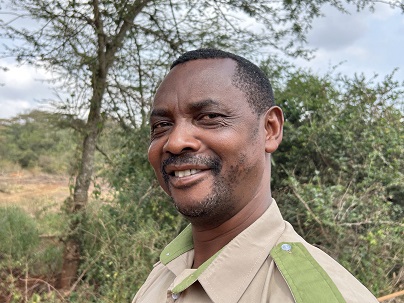 |
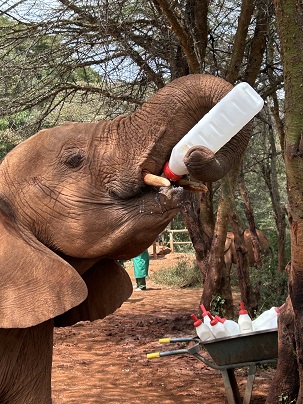
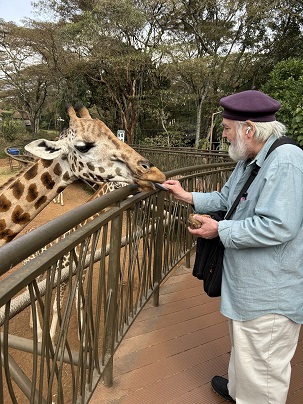
The Elephant and Giraffe orphanages exist largely because of poachers. That is a sad story in this day and age. The British set the stage for large-scale poaching, but with the likes of Donald Trump in office there are even sadder stories involving poaching, including of endangered species. So save your weeping and wailing and visit the elephant and giraffe orphanages if you get a chance. I don’t know which one I liked the best. It was fascinating to stand next to elephants and watch them drink huge bottles of milk, snort up water into their trunks, then quirt it into their mouths, then strip branches of trees of their leaves and in some cases, crush the wooden branches with their mouths and eat the greenish insides. I now know how and what elephants eat. And it was enlightening to see their ears close up and their mouths when they were eating. I now know how they eat. And it was fun watching them play by rolling in the dirt and sucking up dirt in their trunks, then spray it on their backs. Good for the skin, I read. And it was fun for me, at least, to pat an elephant’s thick hide and feel its roughness yet its looseness. They did not mind a pat or two. And it was fun to see the little orphaned zebra hanging out with them and, as one of the caregivers said, thinking that it was in fact an elephant, at least at this stage of its life. It was found lying on the ground dying when it was brought to the elephant orphanage to recover. They don’t have his story. Was his mother poached or was he just abandoned? Oh, there was a baby rhino too! They packed mud on his back with shovels to protect him from insects … This was all much fun but it was the giraffe orphanage that I enjoyed the most. There you get to feed the giraffes from a bowl of their favorite foods, green and brown compressed nutritional pellets. I read later that giraffes, like elephants, are very intelligent. Mine in fact gave me a little nudge whenever I stopped feeding her to have a conversation with tour-guide Stephen Mutuku (photo above); she gently let me know that she was still there and hungry. I then continued to place more food on her long, bluish-purple tongue. The giraffes are a work of art. I don’t know who or what designed them, but the angles, the triangulation of their features, especially of their heads, the large dark luminous eyes, the spotted or maculated hides, the slopes of their backs, the long legs … all speak of something whimsical and other worldly. And such a contrast to the here-and-now, down-to-earthiness of the elephant or the rhino. They are pure magic in the animal kingdom! They are orphaned wonders!
 |
For a strong dose of reality, I took a city walk with with tour-guide John. I learned much. It started near two historical building at the center of the old town of Nairobi, which I learned was not that old. Kenya started out as a railway station around 1900 during colonial times. On one side of the street was a theatre and on the other now a bank but what used to be the center for registering native Africans during British colonial rule. Under British rule all African were required to register in their own country! Guide John was low-keyed and did not make a big deal of this but its implications certainly registered with me. Back “home” on Mau Close at Azania Jay Homes I looked it up. The early Kenyans were much like slaves to the British. Not only did they have to register with the British but their best lands were taken away from them and designated “whites” only. What a deal for native people! It was not till the 1960s that the Kenyans gained their independence from the British — and only then after bloody battles with tribes such as the Mau Mau, who were killed, tortured, and confined to detention camps. The main goal of the British was the extraction of various resources — coffee and tea, cash crops, cotton, hides, oilseeds and and grains, minerals … — and it is said they gave little back to the people. We also visited the McMillan Library, which was initially for whites only. Friend and city-tour guide John did not mention that it was whites-only but a little research on my part quickly revealed that. Real travellers learn a lot of ugly stuff, "shit" if you will; tourists are mostly entertained. I had my homework to do if I wanted the bigger picture.
  |
Putting It All Together, Pamoja
I began before:
The stick he waved in his hand
Was really a magic wand
His smile an expression of joy
…
But let us put it another way:
On Mau Close the cat wanders freely
From building to building but seems to prefer
The protection of Moses at Azania Jay,
The protection of a smiling god with magic wand:
Paka wa chungwa na mweupe.
I, too, prefer his type of protection,
An observant eye that smiles, that watches
Here, there, everywhere.
I am eating lunch at the artsy ArtCaffee
On Ring Road, Westlands Nairobi.
Ooh La La.
Diana Pariken brings me a sprig of rosemary
Over a candle to rid the table
Of flies. It works and the flies go
To another table where diners shoo them away
With excess of effort but little success.
Are the flies politicians running for public office?
I do not think they will get many votes.
Do I have anything at all to say today?
I do but it hides in back of meter,
In back of measured lines, rhymes.
Free it up right now, shoo them all away!
Write something fresh, get undressed!
Turn your poem into a Mau Mau warrior party!
Clear the table of fish on platters — merde! —
But keep the bottle of wine and sing
The song of the elephant, the giraffe, and Dedan Kimathi.
Bow down, howl for the freedom fighter!
Kimathi was hung for having a gun,
Illegal for Kenyans to have under colonial rule,
The ruling coming from the Colonial Secretary.
Today there is a statue of Kimathi
In Nairobi’s Central Business District,
None of the Colonial Secretary.
Loosen the line, clear structure away!
Say something real, make her squeal!
And remember freedom-fighter Ernesto Guevara —
Che, Comandante, Haste Siempre —
Who fought in Cuba and the Congo.
He was finally tracked down in Bolivia
By the CIA and quickly executed
By Bolivian army sergeant Mario Salazar
Under orders from the Bolivian High Command
To prevent Guevara from becoming a martyr.
The effect was quite the opposite;
He has rock-star status among martyrs,
The High Command none!
US President Lyndon “God Damn Vietnam” Johnson —
not among the great ones! — closely monitored events:
He knew!
Think also of recent events in the United States:
The murder of Renee Nicole Good by ICE agent
Jonathan Ross and her final words:
“I’m not mad at you.”
This was before being shot three times in the face
And called a “fucking bitch!” —
Then being labelled a “domestic terrorist”
By President most-unpresidential Donald J. Trump.
She should get the Freedom-From-Clowns
Fighter & Martyr award.
Let him put his name on her grave —
Not the Center for the Performing Arts
With real president John F. Kennedy.
And let him desecrate her grave
by peeing on it If he wants.
It’s who he is! Shit-hole clown, King of Vile.
Think about the many warnings
About a second Trump presidency
And read the poem Orange Jesus.
You, America, were well warned!
De Niro, Schwarzenegger, General John Kelly,
the truly heroic Liz Cheney …
All stood up and sounded the alarm!
You should have known.
The woods are cold now here in Skokie.
It's been almost two-hundred years since
The Potawatomi walked the Death Walk
and their land was taken away.
But some hid out in northern Michigan — Michigami —
and Canada, Kanata, and others came back from Kansa,
As Kansas was known by the indigenous people back then,
And are here right now in the great-white wasteland of snow.
Off Old Orchard Road and Woods Drive in “Big Swam” Skokie
You can see the woods as they once may have looked
To the Potawatomi: Green and lush or snowy and cold.
Natural, healthy, untainted, ununned by the mobs that followed.
You can still visit Mt. Kilimanjaro in Tanzania
Following the “reelection” of Samia Suluhu Hassan;
And you can still visit the Maasai, or speakers of Maa,
in their colorful shukas on the savanna.
They too have had their land taken away!
“Bosha, nitthena?”
“Habari rafiki yangu.”
 |
By Louis Martin